Dropshipping in Lithuania usually starts with the same question: where do I begin, and what will it cost so I do not get the taxes wrong? This guide collects what you need to know in 2026: how dropshipping works, which legal form to choose, which taxes apply, where to sell, how to pick suppliers and what to do in the first 30 days.
Tax figures come from the Lithuanian State Tax Inspectorate (VMI) and apply to 2026. This is not tax advice: check your own situation with an accountant before registering.
What dropshipping is
Dropshipping is a way of selling products you do not hold in stock. A buyer orders in your store or on a marketplace, you pass the order to the supplier, and the supplier ships the product to the buyer. Your earnings are the difference between what the buyer paid and what you pay the supplier.
The biggest advantage: no money tied up in stock, so you can offer thousands of products from day one. The biggest challenge: you never hold the goods, so everything depends on your store showing the right price, stock and delivery time. Stale stock means an order you cannot fulfil; a stale price means selling at a loss.
Is dropshipping legal in Lithuania, and which legal form to choose
Yes, dropshipping is ordinary online retail with different logistics. It needs a registered activity. Most people choose one of two options:
Individual activity (by certificate) | Small partnership (MB) | |
|---|---|---|
Suits | Beginners testing an idea | Growing turnover, separating business and personal money |
Registration | Through "Mano VMI", no setup cost | Through the Centre of Registers, with founding documents |
Liability | All personal assets | Limited to the MB's assets |
Taxes | Income tax on profit, VSD and PSD contributions | Corporate income tax, payouts to the owner taxed separately |
Bookkeeping | Simpler income and expense journal | Full accounting, usually with an accountant |
Most new dropshippers start with individual activity and move to an MB once profit is steady. Note that a business licence (verslo liudijimas) usually does not cover online retail, so check with VMI before buying one.
Dropshipping and taxes in 2026
Personal income tax (GPM) on individual activity
From 1 January 2026, profit from individual activity is taxed as follows (VMI figures):
Annual profit (income minus expenses) | Effective GPM rate |
|---|---|
up to €20,000 | 5% |
€20,000 to €42,500 | rises evenly from 5% to 20% |
above €42,500 | 20%, 25% or 32%, depending on total annual income |
The tax is on profit, not turnover. That matters in dropshipping: if you sell €30,000 of goods and pay suppliers €24,000, roughly the €6,000 difference minus other business expenses is taxed, not the whole amount. Keep your supplier invoices in order.
VSD and PSD contributions
People doing individual activity pay state social insurance (VSD) and compulsory health insurance (PSD). Both are administered by Sodra; the easiest way to see your amount is the Sodra calculator.
VAT: when you must register
Registering as a VAT (PVM) payer is mandatory once your revenue from goods and services supplied in Lithuania exceeds €45,000 in the current or previous calendar year. Below that, registration is optional. Individual activity does not exempt you from it.
The small business scheme (SVS) in Lithuania
Since 1 May 2025 Lithuania has applied a small business VAT scheme (SVS). You can use it if your revenue from goods and services supplied in Lithuania did not exceed €45,000 in the previous calendar year and you do not expect to exceed it in the current one.
What that means in practice:
you do not charge VAT on your sales in Lithuania, so your price to the buyer carries no 21% VAT;
you issue simplified invoices that show no VAT rate or amount;
you cannot reclaim the VAT you pay when buying from suppliers.
When you must register for VAT even below €45,000
This is the most common mistake among new dropshippers. According to VMI, VAT registration is mandatory regardless of turnover if you:
buy services from foreign companies, for example Facebook or Google advertising;
buy goods from VAT payers in other EU countries for more than €14,000 excluding VAT in the current or previous calendar year, for example from Polish suppliers;
provide services to businesses in other EU countries.
The first two apply to dropshipping: almost everyone advertises on Facebook or Google, and many buy from Poland. The good news is that registering does not cancel the SVS: as long as your sales in Lithuania stay within €45,000, you still charge no VAT on them, and you pay VAT only on those foreign purchases, declared monthly.
Buyers in other EU countries
Selling to buyers in Latvia, Estonia or elsewhere in the EU counts as distance selling. As long as those sales across all EU countries together stay within €10,000 excluding VAT per calendar year, Lithuanian rules apply. Above the threshold, VAT is charged at the buyer's country rate, and it can be declared in one place through the One-Stop Shop (OSS) instead of registering in each country.
The SVS in other EU countries
Small sellers who also sell in neighbouring countries have another option: the small business scheme in other EU member states. A business established in Lithuania can use it if its total EU turnover did not exceed €100,000 excluding VAT in the previous calendar year. You then charge no VAT in that country, provided you meet that country's small business scheme conditions.
You register through VMI and receive a VAT number ending in "EX".
A report of sales in each country is filed every quarter.
Once you exceed €100,000 you must report it within 15 working days: you are deregistered and cannot use the scheme for the rest of that year and the next.
The scheme cannot be used while you are registered in the Import One-Stop Shop (IOSS).
Which scheme suits you, OSS or the SVS in other countries, depends on how much you sell in each country. Discuss it with an accountant before you start selling abroad.
Goods shipped from outside the EU
If the supplier ships straight to the buyer from, say, China, the rules get more complex: consignments up to €150 go through the Import One-Stop Shop (IOSS), more expensive ones through regular import with customs. In February 2026 VMI published guidance on how VAT applies to dropshipping specifically and when the seller counts as the supplier of the goods. If you plan to use suppliers outside the EU, read it before you start. The simplest path for a beginner is EU suppliers, where import questions never arise.
Where to sell: your own store or a marketplace
Your own online store
Your own store means your brand, your prices and your customer list. The most popular platforms in Lithuania are Shopify, whose searches in Lithuania grow every year, and WooCommerce; older stores often run on PrestaShop. The downside: you bring the buyers yourself, through ads, search and social media.
Marketplaces
Marketplaces already have the traffic. In Lithuania the largest are Pigu.lt, where one product card can also sell on 220.lv, kaup24.ee and hobbyhall.fi, and Varle.lt. Marketplaces take a commission and insist on complete product cards: an EAN code, dimensions, category properties and descriptions. If the supplier catalog lacks that data, the products cannot be listed.
Marketplaces are often stricter about delivery too. They set how quickly an order must be shipped, track late and cancelled orders, and can lower your products' visibility or even suspend the seller account for them. So for a marketplace, pick suppliers who ship fast and whose delivery times are real.
A practical tip: start on a marketplace to learn quickly which products sell, and grow your own store alongside it.
How to choose dropshipping suppliers
EU suppliers or China
EU suppliers | Suppliers in China | |
|---|---|---|
Delivery to the buyer | Usually 1–5 working days | Often several weeks |
Returns | Simpler, returned within the EU | Expensive and slow |
VAT and customs | Ordinary EU trade | IOSS or import with customs |
Safety and manufacturer information | Usually in the catalog | Often missing |
Price | Higher cost price | Lower cost price, higher risk |
Lithuanian buyers expect delivery within days, and marketplaces penalise late orders. That is why EU suppliers are almost always the safer choice when starting out.
What to look for in a supplier
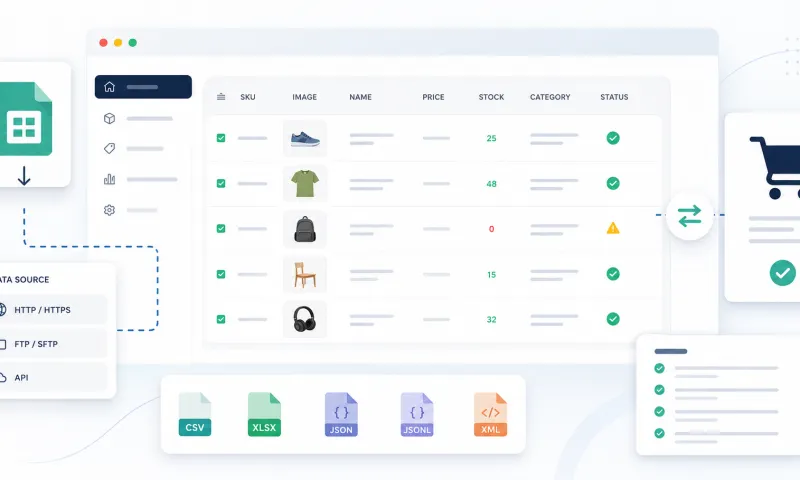
An automatically refreshed catalog. The supplier should provide a product list with prices and stock that refreshes at least once a day. Without it, dropshipping cannot be kept under control.
EAN codes and dimensions. Without them you cannot sell on Pigu.lt or Varle.lt.
Images and descriptions. The fuller the supplier's texts, the less work for you.
Clear delivery times. You promise them to the buyer, so you need to know them.
A returns policy. Ask before you start, not after the first return.
We wrote more about what a supplier should have ready in "What suppliers need before integration".
Staying in control when you have thousands of products
Dropshipping 50 products works by hand. With 5,000 products you cannot keep up: the supplier changes prices and stock every day, and every missed change is either a loss-making sale or a cancelled order. We worked out what that actually costs in "What manual supplier price updates cost".
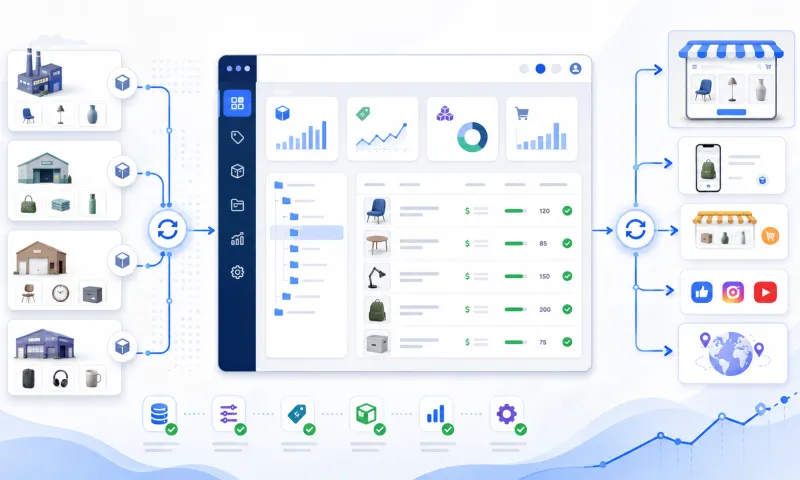
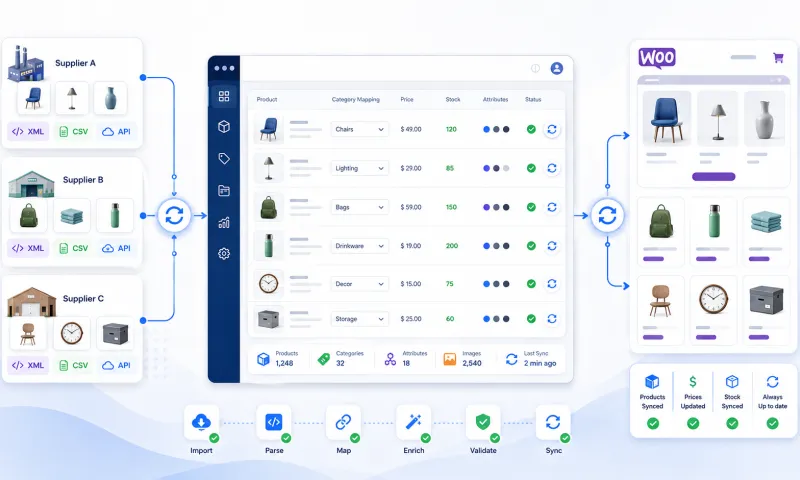
So from the start it pays to have a system that:
imports supplier products with images and descriptions in your language;
applies your margin by category, supplier or price range;
refreshes prices and stock several times a day and takes sold-out products off sale;
sends the same catalog to your own store and to marketplaces.
That is what Unified Suppliers does: connect suppliers, match categories, set your margin, and products appear in your store or on Pigu.lt and look after themselves from then on.
The first 30 days: a dropshipping start plan
Days 1–3. Pick a niche. Choose a category you understand, with demand in Lithuania but no single dominant seller undercutting everyone.
Days 4–7. Suppliers. Contact 2–3 EU suppliers and ask about the catalog file, EAN codes, delivery times and returns.
Days 8–10. Register the activity. Register individual activity through "Mano VMI" or found an MB. Talk to an accountant about VAT and bookkeeping.
Days 11–17. Sales channel. Open a Pigu.lt seller account or a store on Shopify or WooCommerce.
Days 18–24. Load the catalog. Connect supplier catalogs, match categories, set your margin and list the first products. Start with a few hundred, not the whole catalog.
Days 25–30. First sales and adjustments. Watch which products sell, which come back and where prices are too high. Expand the range only after that.
Frequently asked questions
Can I dropship without a company?
Yes, individual activity by certificate, registered through "Mano VMI", is enough. A company (usually an MB) makes sense once profit is steady.
How much does it cost to start dropshipping in Lithuania?
There is no stock to buy, so the main costs are the store platform or marketplace fees, a catalog management tool and advertising. You can start with a few hundred euros a month.
Do I need to be a VAT payer?
Registration becomes mandatory once sales in Lithuania exceed €45,000 in a calendar year. But if you buy Facebook or Google advertising, or more than €14,000 a year of goods from other EU countries, you have to register earlier. In that case, as long as your sales in Lithuania stay within €45,000, you can use the small business scheme (SVS) and charge no VAT on your own sales.
Which taxes apply to dropshipping profit?
For individual activity: income tax on profit (5% up to €20,000 of profit in 2026) plus VSD and PSD contributions to Sodra. For an MB: corporate income tax, with payouts to the owner taxed separately.
Can I dropship on Pigu.lt?
Yes. Pigu.lt lets sellers list products shipped by a supplier, as long as the cards are complete and the delivery times are real. More: selling on Pigu.lt.
Where do I find reliable dropshipping suppliers?
Start with EU suppliers that provide an automatically refreshed catalog with stock and EAN codes. The suppliers whose catalogs you can connect today are on the integrations page.
Conclusion
Dropshipping in Lithuania in 2026 is easy to start and hard to keep tidy: registering takes a day, while looking after the prices, stock and delivery times of thousands of products takes every day. Choose EU suppliers, start with individual activity, watch the €45,000 VAT threshold and automate catalog updates from day one.
Want to know how much time you would save by automating supplier work? Take the supplier automation quiz: 8 questions, 2 minutes.