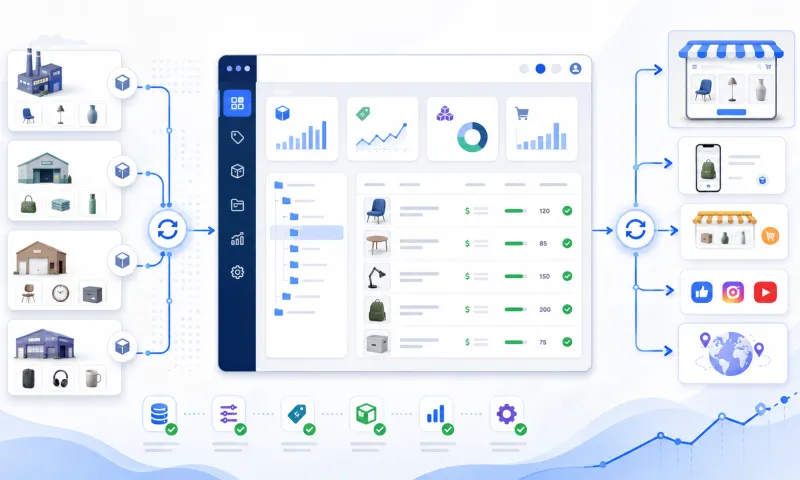
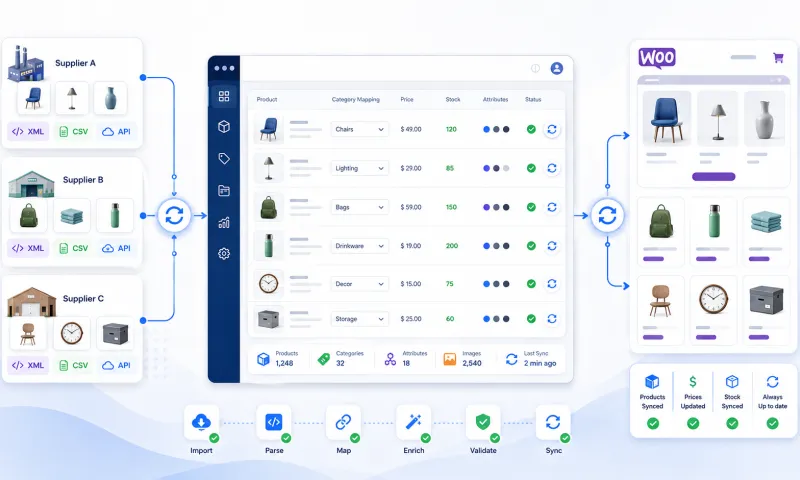
Short answer: yes, but the tool is not what makes the profit. Unified Suppliers handles the technical side of dropshipping: it brings your supplier's products into Shopify, translates the descriptions, applies your markup and keeps prices and stock up to date on its own. Whether the shop makes money depends on three things no automation can replace: the margin after every cost, what it costs to win a buyer, and the niche you pick. This article shows how to work that out before you start.
Why a 40% markup is not 40% profit
The most common mistake when starting out is to multiply the supplier price by 1.4 and treat the difference as profit. That difference still has to pay for VAT, delivery, payment fees, returns and advertising. Let's take one product and do the maths.
Assumptions (an example, not data from any supplier or client):
supplier price excluding VAT: €30.00;
the buyer pays for delivery to a parcel locker, so it costs the shop nothing;
the shop is VAT-registered and the shelf price includes 21% VAT (the Lithuanian rate);
payment and platform fees: about 2.5% of the order;
3% of net revenue set aside for returns and discounts;
one order through Meta or Google ads costs €12.
Price €49.90 | Price €69.90 | |
|---|---|---|
VAT 21% | −€8.66 | −€12.13 |
Revenue excl. VAT | €41.24 | €57.77 |
Supplier price | −€30.00 | −€30.00 |
Payment fees | −€1.25 | −€1.75 |
Returns reserve | −€1.24 | −€1.73 |
Left before advertising | €8.75 | €24.29 |
Advertising per order | −€12.00 | −€12.00 |
Profit per order | −€3.25 | €12.29 |
The same product at €49.90 loses money on every order, even though the "markup" looks healthy. In this example the shop only starts earning from a price of about €54, around 1.8 times the supplier price. Your numbers will differ, but the calculation is the same.
If you offer free delivery, add its cost to the expenses and the price you need goes up. The table also leaves out monthly costs: the Shopify plan, the Unified Suppliers plan, the domain and bookkeeping. Divide them by your monthly orders and subtract them from the profit per order. While orders are few, this part is usually the largest.
If your shop is not VAT-registered (for example under a small business scheme), you don't charge VAT on sales but can't reclaim the VAT on the supplier's invoice either, so count the supplier price including VAT. We cover the tax side in our guide to dropshipping in Lithuania.
Where the buyer comes from matters more than the markup
After the supplier price, advertising is the biggest cost in the table. When every buyer has to be "bought" through Facebook or Instagram, only products with a high price and a high margin stay profitable. But not every sale has to come from ads.
Compare the same product at €54.90 in two channels:
through paid ads (€12 per order) the shop keeps €0.64;
through a price comparison site where the buyer is already looking for that product (say €1.50 per order) it keeps €11.14.
In Lithuania shoppers search on Kaina24.lt, Kainos.lt and Kainoteka.lt and buy on Pigu.lt and Varle.lt; in the Nordics, on CDON. Marketplaces take a commission and price comparison sites usually charge per click, so check their terms before you start. In both cases, though, the buyer arrives already intending to buy, so an order usually costs less than one from social media ads. Unified Suppliers sends the same supplier catalog to Shopify and to these channels, each with its own price. All channels are on the integrations page.
What Unified Suppliers actually solves
Dropshipping shops don't lose money only through thin margins. Often it is small things the owner can't keep up with by hand:
Outdated prices. The supplier raises a price and your shop keeps the old one. Unified Suppliers applies your markup to the latest supplier price, so the margin doesn't melt away.
Selling what the supplier no longer has. An order without stock means a refund, an unhappy customer and, on marketplaces, a worse seller rating. Stock updates automatically and sold-out products leave the shop.
Hours of manual work. Uploading products and checking prices takes time you could spend on selling. We worked out what that costs per month in a separate article.
Product pages that don't sell. Titles and descriptions are translated into the shop's language, and AI helps improve them so the product is found in search too.
Most importantly, a pricing rule can set not only a percentage markup but also the minimum amount you want to earn on a product, for example "a 60% markup, but at least €25". That way even a cheap product never goes out too cheap, and the price is always rounded up, for example to .90.
In the platform, such a rule looks like this:
max($PRICE * 1.6, $PRICE + 25) * 1.21
In words: take the larger of two amounts, the supplier price with a 60% markup or the supplier price plus €25, and add 21% VAT. You can have as many rules as you need: per category, per supplier or per sales channel.
What the tool won't solve
Choosing the niche and the supplier. If a buyer finds the product cheaper on a big marketplace within seconds, automation won't sell it.
Traffic. Products in a shop are not buyers. You need ads, search optimisation or channels where buyers are already looking.
Customer service and returns. You talk to the buyer, and a slow or awkward supplier returns process becomes your problem.
Taxes. VAT and income reporting stay your responsibility.
How to start so the first month doesn't lose money
One supplier, one niche. Start with a supplier that ships from the EU and states clear delivery times.
Up to 1,000 products, not the whole catalog. Pick a few categories and filter products by price, so you can work out their margin and see what sells. Leave bulky, heavy or often-returned items for later.
Work out one order for each category. As in the table above: the price you need to keep a profit after advertising.
Put it into a pricing rule. A markup per category and a minimum profit, so no product goes out too cheap.
Besides Shopify, connect at least one channel where buyers are already searching: a price comparison site or a marketplace.
Measure for 4–6 weeks, then grow the categories that earn, not just the ones that sell.
Frequently asked questions
Does Unified Suppliers sell products or act as a supplier?
No. Unified Suppliers is a tool that moves your suppliers' products into your shop and onto marketplaces. You choose the supplier and agree terms with them yourself; we connect them to your account.
What margin do you need for dropshipping to pay off?
There is no single number, because it depends on what a buyer costs you. In our example with paid ads, profit only appeared once the selling price was around 1.8 times the supplier price. In channels where buyers come cheaper, a smaller markup is enough.
Can I start with one supplier?
Yes, and it is the best way to start. The smallest plan is made for exactly one supplier and one sales channel. Plans and their limits are on the pricing page.
Does the tool protect against loss-making prices when the supplier raises theirs?
Yes, if your pricing rule sets a markup and a minimum profit. The new supplier price is recalculated with your rule and reaches the shop at the next update.
Conclusion
You can run a profitable Shopify store with Unified Suppliers, but the tool is infrastructure, not a business model. It makes sure prices are right, that you only sell what the supplier has, and that you can sell the catalog in several channels without manual work. The profit comes from you: choosing the niche, working out the economics of one order and selling where buyers are already looking. If you'd like to talk through a specific supplier, write to us.